Iron and Hard Water in Ontario Wells: Why It Happens and What Actually Fixes It
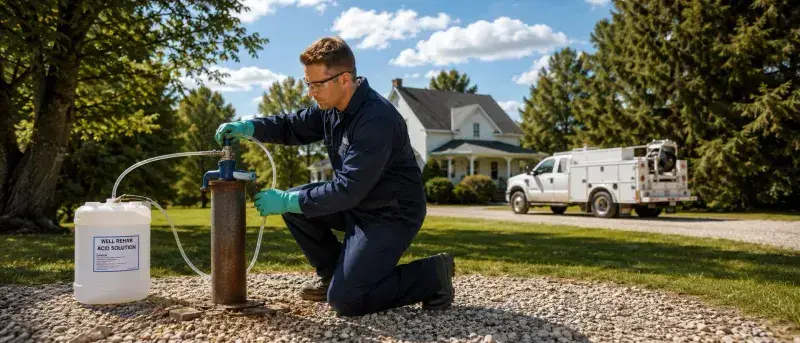
If your well water stains fixtures orange, smells like rotten eggs, or leaves white crust on everything it touches, the cause is almost certainly your local geology — not a failing well or a contamination problem. Groundwater across Simcoe County and Grey County picks up dissolved iron, manganese, calcium, and magnesium as it moves through the glacial sands and limestone bedrock that define this region, and those minerals cause staining, odour, and scale the moment they meet air or a hot water tank. The fix comes in two parts: well acid treatment and rehabilitation to remove the fouling that builds up inside the well itself, and point-of-entry treatment equipment — supplied by a water treatment specialist — to polish the water entering the house. Understanding which problem you have, and which fix addresses it, saves homeowners thousands of dollars in misdirected spending.
After more than six decades drilling and rehabilitating wells across this region, we can say with confidence that iron and hardness are the two most common water complaints we hear — and the two most misunderstood. Here is what is actually happening underground, and what actually works.
Why our groundwater is so iron-rich and hard
The water under Simcoe and Grey County spent thousands of years getting here. Glaciers left behind the thick deposits of sand, gravel, and clay that blanket the region, and beneath them sit the limestone and dolostone bedrock formations of the Niagara Escarpment and the central Ontario plains. As rain and snowmelt percolate down through those materials, the water slowly dissolves what it passes through.
In the sandy lacustrine aquifers around Wasaga Beach and Tiny Township, shallow groundwater moves through iron-bearing sands in a low-oxygen environment — ideal conditions for iron to stay dissolved and invisible until it reaches your taps. In the fractured dolostone and limestone along the Escarpment in Clearview, the Blue Mountains, and Meaford, water dissolves calcium and magnesium carbonate directly out of the rock, producing the hard water the area is known for. And in the clay-overburden wells of Springwater Township and Essa, slower groundwater turnover lets both problems develop together, often with biological fouling on top.
None of this means anything is wrong with your well. It means your well is drawing from exactly the aquifer the region provides — and that a maintenance plan should account for what that aquifer does to wells over time.
The four symptoms and what each one means
Red and orange staining
Dissolved iron is colourless. The moment it meets oxygen — in your pressure tank, your toilet tank, your laundry — it oxidizes into rust-coloured iron oxide and sticks to surfaces. Health Canada’s drinking water guidelines set an aesthetic objective of 0.3 mg/L for iron; many wells in our service area produce several times that. Iron is not a health hazard, but it is a nuisance in the house and a warning sign for the well.
Slime in toilet tanks and aerators
Reddish-brown gelatinous slime is the signature of iron bacteria — naturally occurring microorganisms that feed on dissolved iron and are common across Simcoe County groundwater. They are harmless to people, but inside the well they build thick biofilms that plug screen openings, coat the pump, and give sulphur-reducing bacteria a place to live. If you lift the toilet tank lid and find slime clinging to the flapper, your well almost certainly has an established colony downhole.
Rotten egg smell
Hydrogen sulphide gas produces the classic rotten egg odour, usually strongest after water has sat overnight. In most local wells it comes from bacterial activity in the same biofilm as the iron bacteria. Shock chlorination knocks the smell back temporarily; because the colonies live deep in the screen and the formation around it, the odour typically returns until the biofilm is removed at its source.
Scale on fixtures, in kettles — and in your pump
Hard water deposits calcium carbonate on every surface it touches. What you see on the showerhead is also forming, invisibly, on your well screen, inside your pump, and in your pressure tank and plumbing. Scale shortens the life of water heaters and appliances in the house, and downhole it restricts flow, forces the pump to work harder, and accelerates wear on impellers and check valves — problems that show up as pressure complaints and are often misdiagnosed as pump failures.
How iron and scale slowly choke a well
Fouling is cumulative, and it compounds. Iron oxide, calcium scale, and bacterial slime narrow the openings in the well screen year after year, reducing how much water can enter the well. The water level in the well draws down further during pumping, which exposes more of the screen to oxygen, which accelerates iron oxidation, which fouls the screen faster. Meanwhile the pump runs longer and cycles more often to keep up, drawing more electricity and wearing out years early.
The decline is so gradual that most homeowners cannot pinpoint when it started. Showers run shorter. Irrigation cannot keep up in July. The pump seems to run constantly. By the time the symptoms are obvious, a well that originally produced ten gallons per minute may be delivering a fraction of that — not because the aquifer changed, but because the path into the well is blocked. Left long enough, a fouled well can fail outright during peak summer demand, turning a plannable maintenance job into an emergency service call.
Fixing the well: acid treatment and rehabilitation
The fouling inside the well responds to licensed well acid treatment. The process starts with diagnostics — a controlled yield test against the original well record, water analysis, and where possible a downhole camera inspection — so the chemistry matches the actual deposits. Citric or oxalic acid dissolves iron fouling, often combined with a biocide to eliminate the iron bacteria colonies behind it. Hydrochloric or sulfamic acid handles calcium carbonate scale. The acid is agitated against the fouled surfaces, given contact time, then fully neutralized and pumped out during redevelopment. The well is shock-disinfected and lab-tested before returning to service.
A typical residential rehabilitation costs $2,500 to $6,000 and restores 70 to 100 percent of the well’s original yield. Repeat intervals depend on chemistry: iron bacteria wells may need treatment every 5 to 10 years, heavy-scaling limestone wells every 8 to 15. This is regulated work performed by licensed well technicians under Ontario Regulation 903 — hardware-store chemicals poured down a well can damage the casing, contaminate the aquifer, and create hazardous reactions.
Fixing the house: point-of-entry treatment
Rehabilitation restores the well; it does not change the aquifer’s chemistry. The water entering your home will still carry dissolved iron and hardness, and that is where point-of-entry treatment equipment comes in — water softeners for hardness, dedicated iron filters for higher iron levels, and oxidizing or aeration systems where hydrogen sulphide persists.
That equipment should be specified and supplied by a water treatment specialist working from a proper laboratory analysis of your water, because the right system depends entirely on the numbers: iron concentration and form, hardness, manganese, pH, and sulphide. It is worth getting the well side addressed first — a rehabilitated well sends far less oxidized iron, slime, and sediment downstream, so treatment equipment sized after rehabilitation works better and lasts longer. Ontario’s guidance on testing and treating private water wells covers the free bacteriological testing available to well owners and is a sensible starting point for any water quality investigation.
What to do if you are seeing the signs
Start with a water test, then a well assessment. A lab analysis tells you what is in the water; a yield test against the original well record tells you how much capacity the well has lost to fouling. Together they separate the house-side problem from the well-side problem — and they routinely reveal that a “weak pump” or a “bad softener” is actually a fouled well that a single rehabilitation cycle will fix for years.
Frequently Asked Questions
Why is my well water staining everything orange?
Orange and red-brown staining comes from dissolved iron in your groundwater oxidizing when it meets air. The iron is invisible while it is dissolved in the well, but once it reaches your fixtures, laundry, and toilet tanks, oxygen converts it into rust-coloured iron oxide that sticks to every surface it touches. Staining typically becomes noticeable when iron exceeds about 0.3 mg/L, which is common across the sandy aquifers of Simcoe County. The same iron is also building up inside your well screen and pump, so staining is often the visible symptom of a fouling problem developing underground.
Is iron in well water safe to drink?
Yes — iron in drinking water is an aesthetic problem, not a health hazard. Health Canada sets an aesthetic objective of 0.3 mg/L for iron because above that level water starts to stain, taste metallic, and look discoloured, but there is no health-based maximum for iron itself. Manganese, which often occurs alongside iron in Simcoe County groundwater, is different: Health Canada set a health-based maximum of 0.12 mg/L in 2019, so black staining is worth a proper lab test. Iron bacteria are also not a health risk to people, but the slime they produce fouls wells, pumps, and plumbing aggressively.
What causes the rotten egg smell in well water?
The rotten egg smell is hydrogen sulphide gas, and in most Simcoe and Grey County wells it comes from sulphur-reducing bacteria living in the same biofilm as iron bacteria inside the well. These organisms feed on minerals in the groundwater and release the gas as a by-product, which is why the smell is often strongest first thing in the morning after water has sat in the well overnight. Shock chlorination can knock the odour back temporarily, but if the bacterial colonies are established deep in the well screen and the surrounding formation, the smell returns. A full well rehabilitation that removes the biofilm at its source is the lasting fix.
Will a water softener fix iron in my well water?
Only partly, and only in the house. A softener exchanges hardness minerals and can remove modest amounts of dissolved iron, but higher iron levels, oxidized iron particles, and iron bacteria will foul the softener resin instead of being treated by it. Dedicated iron filters handle the water entering the home — that equipment is properly specified and supplied by a water treatment specialist based on a lab analysis of your water. What no household equipment can do is fix the well itself: iron and scale accumulating on the well screen and pump continue to choke your water supply regardless of what is installed in the basement. That side of the problem is solved by licensed well rehabilitation.
How often does a well need acid treatment for iron fouling?
It depends on your water chemistry and how hard the well works. Wells with active iron bacteria in the sandy aquifers around Wasaga Beach, Tiny Township, and Innisfil often benefit from treatment every 5 to 10 years, while wells scaling with calcium carbonate in the limestone areas along the Escarpment may go 8 to 15 years between treatments. Wells with mild fouling can go decades. After a rehabilitation, a good contractor documents what was found and gives you an expected schedule, and a simple yield check every few years tells you when the next treatment is approaching before you lose pressure.
If your water is staining, smelling, or scaling — or your pressure is not what it used to be — our team can assess the well and give you an honest answer on whether rehabilitation will fix it.