New Well in Simcoe County: Cost, Warning Signs, and When Replacement Beats Rehabilitation
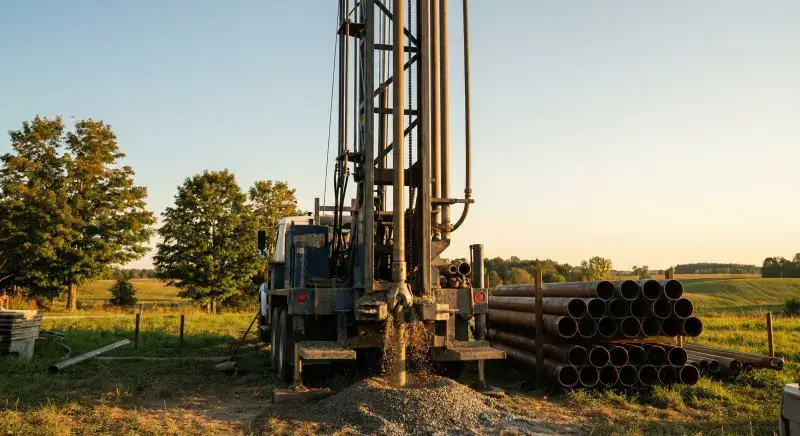
How long does a well last? A properly constructed Simcoe County well can deliver clean, reliable water for thirty to fifty years or more — but every private well eventually reaches a decision point. When yield drops, water quality changes, or pressure falls off, the question becomes whether well rehabilitation will restore performance or whether full replacement is the only sensible answer. Knowing the warning signs early is the difference between a $4,000 service call and a $20,000 capital project — or worse, an emergency well service call when an unmaintained well finally fails.
After more than six decades drilling and servicing wells across Simcoe County and Grey County, our crews have seen every type of well failure the region produces. Most of the time, declining performance is treatable. Occasionally, the underlying problem makes replacement the only sensible answer. Here is how to tell the difference.
Seven warning signs your well may be reaching end of life
1. Yield decline that rehabilitation cannot restore
Most yield decline comes from mineral scaling, iron fouling, or biological growth blocking the well screen — all treatable with proper well rehabilitation through acid treatment. But if a thorough rehabilitation cycle does not restore meaningful capacity, the cause is likely structural (a failed screen, collapsed casing) or aquifer-level (the water-bearing zone itself has declined). Replacement enters the conversation.
2. Casing failure
Steel well casings installed thirty or more years ago can develop corrosion perforations, particularly at joints and in zones of fluctuating water levels. Surface water, road salt, and contaminants flow through these breaches directly into the aquifer. Some breaches can be addressed with a casing liner; severe corrosion across the full casing length usually cannot. A downhole video inspection is the only reliable way to assess casing condition.
3. Persistent bacterial contamination or sulphur smells
Shock chlorination should clear bacterial contamination caused by a one-time event. If E. coli or total coliform return repeatedly after several treatment cycles, the well has a structural problem allowing surface water to enter — a failed annular seal, cracked casing, or damaged well cap. A related warning sign is when well water smells bad and the odour will not clear: a persistent rotten-egg hydrogen sulphide smell often points to biological fouling deep in the well or to surface intrusion that disinfection alone cannot fix. The Ontario Ministry of the Environment, Conservation and Parks (MECP) outlines the right disinfection and testing protocol for private wells. Some of these issues are repairable; others mean the well’s sanitary integrity cannot be restored.
4. Sand or sediment in your water
A properly developed well in good condition should not produce sand. When sand or fine sediment appears, the well screen has likely corroded through or collapsed, or the formation around the screen has degraded. Some screen failures can be addressed by installing a new stainless steel screen inside the existing well; severe cases require new well drilling in Simcoe County.
5. Aquifer-level decline and low well water pressure
Long-term water-table drops driven by development, increased regional demand, or changing precipitation patterns can leave a once-productive well unable to sustain household use. The first symptom is usually low well water pressure that returns even after pump service, followed by recovery times stretching into hours between draws. Lowering the pump or deepening the well sometimes helps, but if the well bottom already sits in the productive zone, a deeper new well in a more sustainable aquifer is often the better long-term answer. Our Simcoe County well depth and aquifer map shows typical drilling depths by township.
6. Wells predating modern Ontario construction standards
Ontario Regulation 903 sets the construction standards for new wells. Some wells drilled in the 1960s and 1970s — particularly hand-dug wells, shallow driven points, and bored wells without proper grouting — were built to standards that do not meet current requirements for casing depth, annular sealing, or surface protection. These wells can pass for years without obvious problems, then fail rapidly when conditions change. You can look up the original construction record for most wells drilled after 1946 in the MECP’s Well Records map.
7. Cross-contamination from neighbouring land use
Wells on properties surrounded by agricultural activity, septic systems, road infrastructure, or industrial operations can experience gradual contamination from sources outside the property owner’s control. When water quality issues persist despite treatment, the well’s source water may be permanently compromised. A new well in a properly protected aquifer is sometimes the only path back to reliable potable water.
The rehabilitation-versus-replacement decision
The first instinct when a well starts producing less water is often to assume replacement is needed. In our experience, that instinct is wrong most of the time. Most yield decline in Simcoe County wells is caused by mineral scaling and iron fouling that can be dissolved with proper acid rehabilitation, restoring 70 to 100 percent of the original yield at a fraction of the cost of a new well.
The economics make rehabilitation the right starting point for most private well problems:
- Acid rehabilitation: $2,500 to $6,000 depending on well depth and fouling severity.
- New well plus pump installation — the typical well replacement cost in Ontario: $18,000 to $30,000 or more depending on depth, aquifer conditions, and any necessary water treatment.
Rehabilitation does not always work, however. The diagnostic step — a controlled yield test, water analysis, and where possible a downhole video inspection — is what tells you upfront whether rehabilitation is likely to succeed. A well with sound casing and screen suffering from mineral fouling almost always recovers. A well with structural damage, severely corroded casing, or an underlying aquifer problem will not. Reputable well contractors will tell you which category your well falls into before any chemistry is added.
Simcoe County’s geological reality
The condition and lifespan of wells across our service area is shaped heavily by local geology. Properties around Wasaga Beach and Tiny Township sit on sandy lacustrine aquifers rich in dissolved iron — wells here typically need rehabilitation for iron fouling every five to ten years and may experience screen failure as a primary end-of-life mode. The fractured dolostone aquifers along the Niagara Escarpment in The Blue Mountains, Clearview, and Meaford produce hard water that aggressively scales well screens with calcium carbonate; rehabilitation works well, but neglected wells in these areas can develop severe long-term buildup. Wells in the clay overburden of Springwater and Essa Township face slower groundwater turnover, which can accelerate biological fouling and complicate water-quality issues when they appear.
Hand-dug wells on heritage farmsteads in Adjala-Tosorontio, Mulmur, and Melancthon present a different situation entirely. Many of these wells have been in service for a century or more and were not built to modern standards. When they fail, modern replacement with a properly drilled and grouted well is typically the only path forward — and Ontario regulation requires the old well to be properly decommissioned by a licensed contractor when it is taken out of service.
What to do if you suspect your well is at end of life
If your well is showing any of the signs above, the right next step is a professional well assessment rather than an immediate decision about replacement. A licensed well contractor in Ontario can perform a yield test, water analysis, and visual inspection to determine whether rehabilitation will resolve the issue or whether replacement is genuinely necessary. The diagnostic work is inexpensive and gives you a clear path forward — including, in many cases, the welcome news that your well has years of useful life left after a proper rehabilitation cycle.
Frequently Asked Questions
How long does a well last in Ontario?
A well drilled to modern standards in Simcoe County typically lasts thirty to fifty years, and properly maintained wells often produce reliably for longer. Lifespan depends on construction quality, aquifer chemistry, and how aggressively local groundwater fouls the well screen. Wells in sandy iron-rich aquifers may need rehabilitation every five to ten years; wells in stable dolostone aquifers often go much longer between service intervals.
How much does a new well cost in Simcoe County?
A new drilled well plus pump installation in Simcoe County generally runs $18,000 to $30,000 or more, depending on depth, aquifer conditions, and any required water treatment. Acid rehabilitation of an existing well typically costs $2,500 to $6,000 — a fraction of the price of replacement — which is why a proper diagnostic should always come before any decision to replace. The cost of a new well in Ontario can climb higher when bedrock depth, well decommissioning, or treatment systems are involved.
Can a well be repaired instead of replaced?
In most cases, yes. Most yield decline comes from mineral scaling, iron fouling, or biological growth that responds well to acid rehabilitation, and many screen problems can be addressed by installing a new stainless steel screen inside the existing well. Replacement only becomes necessary when the casing has failed across its length, the sanitary seal cannot be restored, or the aquifer itself has declined beyond what deepening can fix.
How do I know if my well pump or my well is the problem?
Pump problems usually appear suddenly — pressure drops, the pump cycles constantly, or water stops entirely — and the well itself produces normal yield once the pump is serviced or replaced. Well problems develop gradually: declining yield over months, sediment in the water, changing water quality, or recovery times getting longer between draws. A licensed well contractor can run a controlled yield test to separate the two before any equipment is replaced.
What are signs of a failing well?
The most common signs of a failing well are declining yield, sand or sediment in the water, persistent bacterial contamination after disinfection, sulphur or rotten-egg smells from hydrogen sulphide, and low well water pressure that does not improve after pump service. Visible problems with the well cap, casing, or surrounding ground are red flags as well. Any of these warrant a professional assessment before they escalate into an emergency.
If you would like an honest assessment of your well’s condition, or want to discuss whether rehabilitation or replacement is the right answer for your property, our team is available to help.