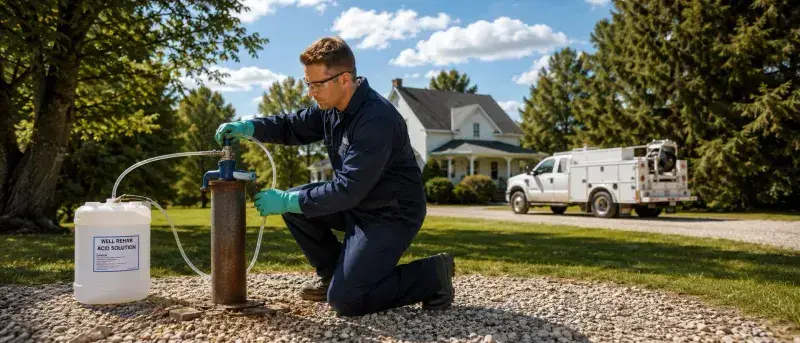
Well Acid Treatment & Rehabilitation in Tiny Township
Professional acid treatment services for Tiny Township homes, farms, and businesses.
Tiny Township wells face one dominant fouling problem: severe iron bacteria colonization in the sandy dune-area aquifers. The combination of iron-rich groundwater, warm summer aquifer temperatures, and the stagnation cycles typical of seasonal cottage use creates ideal conditions for iron bacteria to thrive. Many Tiny Township cottage wells experience dramatic yield decline within 10 to 15 years of original drilling, with iron bacteria biofilms progressively choking the well screen. Mighton's Well Services performs combined acid and biocide treatment on Tiny Township wells, dissolving the iron precipitates and eliminating the bacterial colonies in a single treatment cycle. Pre-season rehabilitation in April or May is the typical pattern for cottage properties wanting to ensure full capacity before summer use.
Local to Tiny Township
Based just 35 min away in Stayner. We know the geology and well conditions in your area from decades of experience.
Licensed & Insured
MECP Licensed Well Contractor #C-8303. All work to Ontario Regulation 903 standards with Jeff Mighton (Class 1 & Class 4).
60+ Years Experience
Family-owned since 1964. Trusted by thousands of homeowners, farmers, and businesses across Simcoe County and Grey County.
What to Expect for Acid Treatment in Tiny Township
When our team arrives at your property in Tiny Township, here's how the process works. Learn more about our full acid treatment process.
Yield Test & Site Assessment
We start with a controlled drawdown test to measure the well's current yield and recovery rate, comparing it to the original well record. The static water level, pump performance, and any historical yield data tell us how much production has been lost and how quickly the decline has happened. This data is the foundation of the treatment plan.
Water Analysis & Downhole Inspection
We collect water samples for laboratory analysis to identify which minerals are present and at what concentrations. Where conditions allow, we run a submersible video camera through the well to see the deposits directly — calcium scale, iron fouling, biological growth, screen condition. This combined diagnostic tells us exactly what chemistry is needed and what yield improvement to expect.
Treatment Plan & Cost Estimate
Based on the diagnostics, we develop a treatment plan covering acid type, concentration, contact time, and any mechanical agitation needed. We provide a firm written estimate covering pump removal, chemicals, treatment labour, redevelopment, disinfection, and water testing. The plan also identifies any expected yield improvement and the realistic ceiling on what rehabilitation can achieve.
Acid Treatment & Mechanical Agitation
On treatment day, the pump is pulled and the well is prepared. The acid is introduced at the calculated concentration — typically a slow gravity feed or pumped delivery to the fouled zone. Mechanical agitation by surging, brushing, or air injection ensures the acid contacts every fouled surface. Contact time is held to the duration needed for the chemistry to fully dissolve the target deposits.
Redevelopment, Disinfection & Verification
After treatment, the well is thoroughly pumped to remove all dissolved deposits and spent acid, with pH monitoring to confirm full neutralization. The well is shock-disinfected, redeveloped until water runs clear, and the pump is reinstalled. A final drawdown test verifies the yield improvement and a water sample goes to the lab for bacterial and chemical testing. We do not return the well to service until results confirm it is safe.
Common Acid Treatment Issues in Tiny Township
Severe iron bacteria colonization in sandy dune-aquifer wells
Tiny Township groundwater is rich in dissolved iron, and the warm sandy aquifer temperatures during summer create ideal habitat for iron bacteria. Within a decade or two of drilling, iron bacteria biofilms can grow thick enough to dramatically reduce flow through well screens. The same well that produced 15 gallons per minute when drilled may produce 3 or 4 by the time the owner notices the problem.
Combined acid and biocide treatment addresses both the iron precipitates and the bacterial colonies producing them. We use citric or oxalic acid to dissolve the iron, followed by chlorine shock to eliminate the bacteria. Most Tiny Township wells respond dramatically — yield often returns to near-original well-record values.
Cottage stagnation cycles accelerating fouling
Cottage wells that sit unused for weeks between seasonal visits foul faster than continuously-used wells. The stagnation creates ideal conditions for iron bacteria to colonize, and the dissolved oxygen and temperature changes during periods of disuse accelerate mineral precipitation. Annual cottage owners often see their wells decline faster than year-round residential wells in the same area.
For seasonal cottage wells, we recommend preventive rehabilitation every 5 to 7 years rather than the 10 to 15 typical for continuously-used wells. Pre-season treatment in April or May fits cleanly into the cottage opening routine and ensures full capacity before peak summer use.
Sand-influx complications during well redevelopment in loose dune formations
Aggressive post-treatment pumping in the loose dune-area sand around Tiny Township can pull fine sand into the well from the surrounding formation. Without careful technique, the redevelopment that should flush dissolved deposits can instead introduce sand into the well.
We use controlled-flow redevelopment with surging cycles rather than continuous high-volume pumping. Where formations are particularly prone to sand, we install a temporary sand separator on the discharge during redevelopment. The result is a cleaner well without sand collateral problems.
Schedule Tiny Township Cottage Rehabilitation Before Opening Weekend
For Tiny Township cottage owners, the ideal timing is rehabilitation in April or early May — before the opening weekend rush. The work fits between rental seasons or seasonal use periods, the well is at full capacity for peak summer use, and you avoid the awful situation of opening the cottage to a well that cannot keep up with weekend guest demand.
Need Acid Treatment in Tiny Township?
Call us for a free phone consultation or request a site visit. We're your local experts.
Acid Treatment in Tiny Township: Frequently Asked Questions
My Tiny Township cottage water has rust-coloured slime and stains everything. Is it the well?
How often should Tiny Township cottage wells be treated?
Can you treat my Tiny Township well while I am away from the cottage?
How much does Tiny Township well rehabilitation cost?
Will iron bacteria definitely come back after treatment?
Other Services We Provide in Tiny Township
Beyond acid treatment, we offer a full range of well and water services in Tiny Township:
We Also Provide Acid Treatment in Nearby Areas
Serving communities across Simcoe County and Grey County from our home base in Stayner.
Serving Tiny Township and Surrounding Areas
Ready to Get Started in Tiny Township?
Contact our experienced team for a free consultation and estimate. Over 60 years of trusted service.