Well Acid Treatment Explained: How Rehabilitation Restores a Low-Yield Well
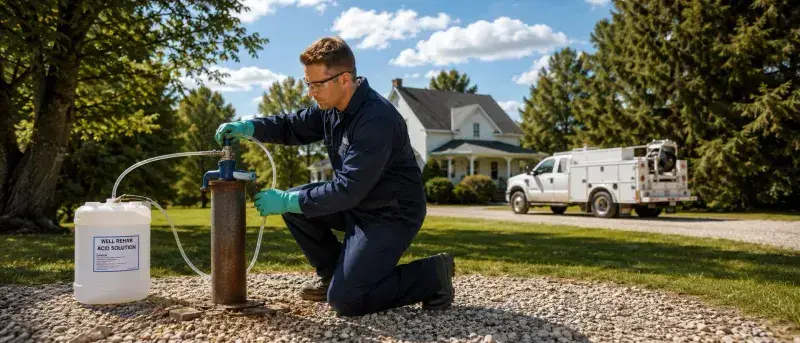
Well acid treatment is a licensed rehabilitation procedure that dissolves the mineral scale, iron fouling, and bacterial biofilms choking a well screen — restoring 70 to 100 percent of the original yield in most cases, for $2,500 to $6,000 instead of the $18,000 to $30,000 or more a replacement well costs. If your well produces less water every year but the casing and screen are structurally sound, well acid treatment and rehabilitation is almost always the right first move, and this article explains exactly how it works from diagnosis to the final water test.
After more than six decades drilling and servicing wells across Simcoe County and Grey County, we have rehabilitated hundreds of wells that owners had quietly started budgeting to replace. Most of them did not need replacing. They needed the deposits removed.
What actually fouls a well
Groundwater across our region carries dissolved calcium, iron, manganese, and other minerals picked up from the formations it passes through. When that water moves through a well screen and into the casing, small changes in pressure, temperature, and oxygen exposure cause those minerals to come out of solution — right at the screen, exactly where you can least afford blockage.
Three culprits account for nearly all the fouling we see:
- Mineral scale. Calcium carbonate precipitates as hard white-grey scale on screens and casing walls. Wells in the limestone and dolostone aquifers along the Niagara Escarpment — Clearview, The Blue Mountains, Meaford — are especially prone, because the same dissolved limestone that makes local water hard deposits itself on every surface the water touches. Over decades, screen openings can narrow from millimetres to near-zero.
- Iron and manganese oxide. Dissolved iron oxidizes into rust-coloured deposits; manganese forms black deposits that stain fixtures and laundry. Iron fouling is the most common cause of yield decline in the sandy aquifer wells around Wasaga Beach and Tiny Township, where shallow groundwater is naturally iron-rich.
- Iron bacteria. These naturally occurring microorganisms feed on dissolved iron and produce slimy, gelatinous biofilms that can block screen openings completely. Reddish-brown slime in the toilet tank and water that starts cloudy then clears are their classic signatures.
Left alone, these deposits compound year after year. Showers run shorter, the pump runs longer, irrigation cannot keep up — the slow-motion decline that owners often mistake for a dying well or a failing pump. (If your symptoms appeared suddenly rather than gradually, the pump may genuinely be the problem — our pump and pressure systems team can isolate that quickly.)
How acid treatment works, step by step
A proper rehabilitation is a diagnostic-first, verify-last procedure. Here is the sequence we follow on every well acid treatment job.
1. Diagnosis and yield test
Before any chemistry is considered, we measure the static water level and run a controlled drawdown test to determine the well’s actual current yield, comparing it against the original well record. Where conditions allow, a downhole video camera shows us the deposits directly — scale, iron fouling, biological growth, and screen condition. Water samples and visible deposits are tested to identify exactly which minerals are present. This step also catches the wells that should not be treated: structural damage or aquifer decline will not respond to acid, and it is far better to know that before spending money on chemistry.
2. Chemical selection
The acid is matched to the fouling. Hydrochloric or sulfamic acid dissolves calcium carbonate scaling. Citric or oxalic acid targets iron oxide deposits, often paired with a biocide to eliminate the iron bacteria colonies that caused the fouling in the first place. All chemicals used are approved for water well rehabilitation under Ontario Regulation 903, and concentrations are adjusted for casing condition — older galvanized steel casings get gentler chemistry and shorter contact times than modern stainless steel and PVC construction.
3. Placement
The pump is pulled and the acid is introduced at the calculated concentration, typically by slow gravity feed or pumped delivery directly to the fouled zone. For wells where the screen is the primary restriction, packers or weighted hoses concentrate the treatment at the screen interval — using less total acid while producing the biggest yield improvement where it matters.
4. Agitation and contact time
Acid that only touches the top of a deposit dissolves the top of a deposit. Mechanical agitation — surging, brushing, or air injection — drives the chemistry into every fouled surface and into the formation immediately around the screen. Contact time is then held for the duration the specific chemistry needs to fully dissolve the target deposits.
5. Neutralization
Before anything else happens, all remaining acid is neutralized to safe pH. This is monitored, not assumed — pH readings confirm the well has returned to neutral before redevelopment finishes. Neutralization is one of the key reasons this is licensed work rather than a DIY project: uncontrolled acid left in a well can damage the casing and contaminate the aquifer.
6. Redevelopment and surging
The well is pumped and surged until the water runs clear, removing all dissolved deposits and spent chemistry from the well bore and the surrounding formation. This step re-establishes clean flow paths from the aquifer into the well — skipping or shortcutting it leaves debris in the formation and undercuts the whole treatment.
7. Disinfection
The well is shock-chlorinated following Ontario guidelines, as required any time a well is opened for service. The pump is reinstalled and the system brought back online.
8. Post-treatment yield test and water analysis
A final drawdown test measures the yield improvement against the pre-treatment baseline, and a water sample goes to a certified laboratory for bacterial and chemical analysis. The well does not return to drinking-water service until results confirm it is safe — typically three to five business days. You receive the complete treatment record: chemicals used, contact time, before-and-after yield, and test results, so the next service call has the full history to work from.
What results to expect
Most rehabilitated wells regain 70 to 100 percent of their original documented yield. The exact recovery depends on how severe the fouling was, whether the structure is sound, and what the aquifer can actually produce — treatment restores access to the aquifer’s capacity, it cannot exceed it. The diagnostic work up front is what lets a contractor give you a realistic expectation rather than a hopeful one, and a firm written estimate before any chemistry is added.
The economics are straightforward:
- Acid rehabilitation: $2,500 to $6,000, depending on well depth, fouling severity, and chemistry required.
- New well plus pump installation: $18,000 to $30,000 or more, depending on depth, aquifer conditions, and any required treatment systems.
When the well structure is sound, rehabilitation costs a fraction of replacement — which is why the diagnostic should always come before any decision to drill new.
How often wells need treatment
Rehabilitation is effective but not permanent. The same water chemistry that fouled the well the first time keeps flowing, so wells in fouling-prone aquifers typically need treatment every five to ten years — the iron-rich sandy formations around Wasaga Beach and Tiny Township, and the hard-water dolostone wells of the Escarpment communities, are the repeat customers. Wells in milder chemistry may go fifteen years or more between cycles. A yield check every few years is the cheap way to catch the next round of fouling before it becomes a no-water emergency in February.
Safety, licensing, and why this is not a DIY job
Well acid treatment in Ontario is regulated work. Ontario Regulation 903 under the Ontario Water Resources Act governs well construction and maintenance across the province, and the Ministry of the Environment, Conservation and Parks (MECP) licenses the contractors and technicians who perform it — Mighton’s Well Services holds MECP well contractor licence C-8303. The MECP’s guidance on maintaining and servicing private wells is clear that work of this kind belongs with licensed professionals.
The reasons are practical, not bureaucratic. Hardware-store chemicals dumped down a well at uncontrolled concentrations can perforate casings, kill a pump, produce hazardous gas reactions in a confined space, and push contamination into the aquifer your neighbours also draw from. A licensed treatment stays contained in the well, is fully neutralized, and is verified safe by laboratory testing before anyone drinks the water.
When acid treatment is not the answer
Rehabilitation fixes fouling. It does not fix structure. If the casing has corroded through, the screen has collapsed, the sanitary seal has failed, or the aquifer itself has declined, no amount of chemistry will bring the yield back — and an honest contractor tells you that after the diagnostic, not after the invoice. Sand in the water, persistent bacterial contamination that returns after disinfection, and yield that a full treatment cycle cannot restore all point toward structural problems. We cover those failure modes in detail in our guide to the signs you need a new well, including when replacement genuinely is the smarter spend.
For everything else — the gradual, years-long decline that describes the large majority of low-yield wells in Simcoe County and Grey County — rehabilitation is the right starting point, and the diagnostic work will confirm it before you commit to anything.
Frequently Asked Questions
What does well acid treatment actually do?
Acid treatment chemically dissolves the mineral scale, iron oxide deposits, and iron bacteria biofilms that build up on a well screen and in the formation around it, restoring the open flow paths that let water enter the well. The acid is matched to the specific fouling — hydrochloric or sulfamic acid for calcium scaling, citric or oxalic acid for iron fouling — then agitated, neutralized, and thoroughly removed during redevelopment. The well itself is not altered; treatment simply restores access to the water the aquifer was always capable of delivering.
How much does well acid treatment cost in Ontario?
A typical residential acid treatment in Simcoe County and Grey County runs $2,500 to $6,000 depending on well depth, fouling severity, and the chemistry required. Deeper wells, severely fouled wells, or wells needing multiple treatment cycles cost more. That compares to $18,000 to $30,000 or more for a new drilled well plus pump installation, which is why rehabilitation is usually the most cost-effective answer when the well structure is sound. A firm written estimate follows the diagnostic work, before any chemistry is added.
How often does a well need acid treatment?
It depends on local water chemistry. Wells in fouling-prone aquifers — sandy iron-rich formations around Wasaga Beach and Tiny Township, or hard-water dolostone along the Niagara Escarpment — commonly need rehabilitation every five to ten years. Wells in milder chemistry can go fifteen years or more between treatments, and some never need a second cycle. After an initial rehabilitation, the treatment report documents what was found, and a simple yield check every few years tells you when the next treatment is approaching before you lose water.
Is acid treatment safe for my well and drinking water?
Yes, when performed by a licensed well contractor using acids approved for water well rehabilitation under Ontario Regulation 903. The chemistry stays contained within the well, is fully neutralized with pH monitoring, and is removed during redevelopment. The well is then shock-disinfected and a water sample goes to a certified laboratory — the well does not return to service until results confirm the water is safe. The real danger is DIY treatment with hardware-store chemicals at uncontrolled concentrations, which can hole casings, contaminate the aquifer, and produce hazardous reactions.
When is acid treatment not the right answer?
Acid treatment only fixes fouling — it cannot repair a corroded-through casing, a collapsed screen, a failed sanitary seal, or an aquifer that has genuinely declined. If the diagnostic work shows structural damage or aquifer-level problems, rehabilitation will not restore yield no matter how much chemistry is applied, and replacement or major repair becomes the conversation. A reputable contractor runs the yield test and inspection first and tells you which category your well falls into before any money is spent on treatment.
If your well is producing less water than it used to and you want a straight answer on whether rehabilitation will bring it back, our team is available to help.