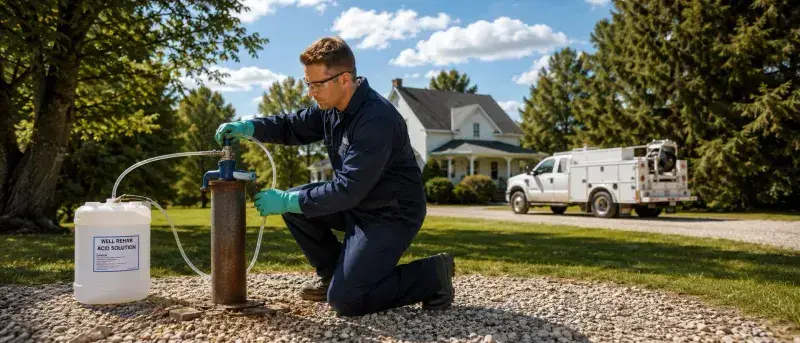
Well Acid Treatment & Rehabilitation in Innisfil
Professional acid treatment services for Innisfil homes, farms, and businesses.
Innisfil's rapid growth has put pressure on wells across the township in ways that accelerate fouling. Properties subdivided from former farmland often have wells originally drilled for lower-demand farm households now serving year-round residential families with multiple bathrooms and irrigation. The increased pumping cycles speed up iron and mineral precipitation, and wells that would have had decades of useful life under farm demand can decline within fifteen to twenty years of higher-demand residential use. Mighton's Well Services performs targeted rehabilitation on Innisfil wells with chemistry matched to the specific aquifer — most Innisfil wells foul primarily with iron given the sandy lake-plain geology. Pre-season treatment fits well with the typical Innisfil property pattern of summer-peak demand from irrigation and full-time household use.
Local to Innisfil
Based just 45 min away in Stayner. We know the geology and well conditions in your area from decades of experience.
Licensed & Insured
MECP Licensed Well Contractor #C-8303. All work to Ontario Regulation 903 standards with Jeff Mighton (Class 1 & Class 4).
60+ Years Experience
Family-owned since 1964. Trusted by thousands of homeowners, farmers, and businesses across Simcoe County and Grey County.
What to Expect for Acid Treatment in Innisfil
When our team arrives at your property in Innisfil, here's how the process works. Learn more about our full acid treatment process.
Yield Test & Site Assessment
We start with a controlled drawdown test to measure the well's current yield and recovery rate, comparing it to the original well record. The static water level, pump performance, and any historical yield data tell us how much production has been lost and how quickly the decline has happened. This data is the foundation of the treatment plan.
Water Analysis & Downhole Inspection
We collect water samples for laboratory analysis to identify which minerals are present and at what concentrations. Where conditions allow, we run a submersible video camera through the well to see the deposits directly — calcium scale, iron fouling, biological growth, screen condition. This combined diagnostic tells us exactly what chemistry is needed and what yield improvement to expect.
Treatment Plan & Cost Estimate
Based on the diagnostics, we develop a treatment plan covering acid type, concentration, contact time, and any mechanical agitation needed. We provide a firm written estimate covering pump removal, chemicals, treatment labour, redevelopment, disinfection, and water testing. The plan also identifies any expected yield improvement and the realistic ceiling on what rehabilitation can achieve.
Acid Treatment & Mechanical Agitation
On treatment day, the pump is pulled and the well is prepared. The acid is introduced at the calculated concentration — typically a slow gravity feed or pumped delivery to the fouled zone. Mechanical agitation by surging, brushing, or air injection ensures the acid contacts every fouled surface. Contact time is held to the duration needed for the chemistry to fully dissolve the target deposits.
Redevelopment, Disinfection & Verification
After treatment, the well is thoroughly pumped to remove all dissolved deposits and spent acid, with pH monitoring to confirm full neutralization. The well is shock-disinfected, redeveloped until water runs clear, and the pump is reinstalled. A final drawdown test verifies the yield improvement and a water sample goes to the lab for bacterial and chemical testing. We do not return the well to service until results confirm it is safe.
Common Acid Treatment Issues in Innisfil
Subdivision wells originally sized for farm demand struggling with residential use
Many Innisfil residential properties sit on lots subdivided from former farmland, with wells originally drilled to support farm-scale household demand. Modern residential families with multiple bathrooms, dishwashers, irrigation, and full-time use put significantly more demand on these wells than the original farm household. The increased pumping cycles accelerate fouling and reveal yield limits that did not appear under farm use.
Rehabilitation restores yield to the level the well can actually provide from its aquifer, often enough to support the new residential demand pattern. For wells genuinely undersized for current use, the diagnostic work tells us upfront so you know whether rehabilitation will resolve the demand mismatch or whether a deeper well is needed.
Iron fouling accelerated by higher pumping volumes
Innisfil's sandy lake-plain aquifer is rich in dissolved iron, and higher pumping volumes from increased residential demand accelerate iron precipitation on well screens. Wells that experienced gradual decline under farm use can decline rapidly once residential demand cycles increase.
Combined acid and biocide treatment dissolves iron precipitates and eliminates the iron bacteria colonies producing them. Citric or oxalic acid chemistry for the iron, with chlorine shock for the bacterial component. Most Innisfil wells respond well to this treatment with substantial yield recovery.
Lakefront property wells with elevated demand and seasonal fluctuations
Lakefront Innisfil properties on Lake Simcoe see seasonal demand swings — quiet shoulder seasons with low use, peak summers with full irrigation, multiple bathrooms in continuous use, and dock activities. The fluctuating demand pattern can mask gradual fouling because owners only notice the limit during peak season.
Pre-season yield testing in April or May identifies wells approaching their fouled-state yield limit before peak summer demand arrives. Rehabilitation booked in May or June restores capacity for peak use and fits cleanly into the shoulder-season schedule.
Yield-Test Innisfil Wells Before Peak Summer Demand
For Innisfil properties, the ideal timing is a yield test in March or April followed by rehabilitation in May if needed — before summer demand from irrigation and family use exceeds well capacity. Pre-season scheduling avoids the awful situation of discovering the well cannot keep up during a heat wave with guests visiting.
Need Acid Treatment in Innisfil?
Call us for a free phone consultation or request a site visit. We're your local experts.
Acid Treatment in Innisfil: Frequently Asked Questions
My Innisfil residential well was fine until we moved in full-time. Why is yield dropping?
How much does Innisfil well rehabilitation cost?
Can rehabilitation fix a well that has never been able to keep up with our family use?
Should I connect to Innisfil municipal water instead?
How long will Innisfil rehabilitation last?
Other Services We Provide in Innisfil
Beyond acid treatment, we offer a full range of well and water services in Innisfil:
We Also Provide Acid Treatment in Nearby Areas
Serving communities across Simcoe County and Grey County from our home base in Stayner.
Serving Innisfil and Surrounding Areas
Ready to Get Started in Innisfil?
Contact our experienced team for a free consultation and estimate. Over 60 years of trusted service.