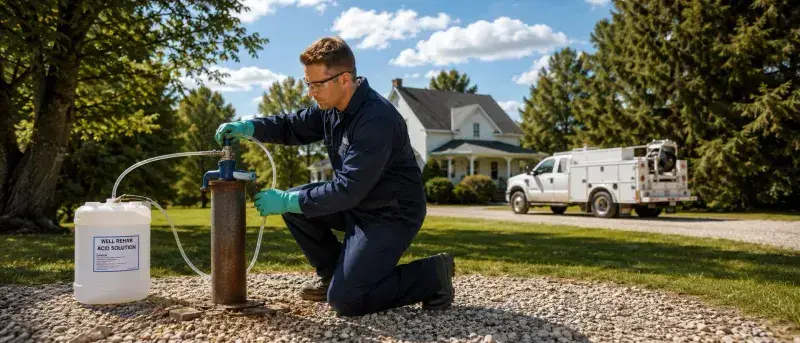
Well Acid Treatment & Rehabilitation in Meaford
Professional acid treatment services for Meaford homes, farms, and businesses.
Meaford's agricultural base means wells in the municipality work harder than most — irrigation, livestock watering, and rural household demand combine to push wells through hundreds of cycles each summer. That heavy use accelerates fouling, and many Meaford wells reach the point of yield decline faster than residential-only wells elsewhere in the region. The geology adds calcium scaling to the picture: most of Meaford sits on Paleozoic limestone and dolostone bedrock, and wells drilled into those formations accumulate calcium carbonate scale just like wells across the Escarpment to the south. Mighton's Well Services performs rehabilitation on farm and residential wells across Meaford, with chemistry matched to whichever mineral fouling is dominant — and often both. Treatment scope and concentration scale up for agricultural wells, but the underlying methodology produces the same dramatic yield recovery.
Local to Meaford
Based just 40 min away in Stayner. We know the geology and well conditions in your area from decades of experience.
Licensed & Insured
MECP Licensed Well Contractor #C-8303. All work to Ontario Regulation 903 standards with Jeff Mighton (Class 1 & Class 4).
60+ Years Experience
Family-owned since 1964. Trusted by thousands of homeowners, farmers, and businesses across Simcoe County and Grey County.
What to Expect for Acid Treatment in Meaford
When our team arrives at your property in Meaford, here's how the process works. Learn more about our full acid treatment process.
Yield Test & Site Assessment
We start with a controlled drawdown test to measure the well's current yield and recovery rate, comparing it to the original well record. The static water level, pump performance, and any historical yield data tell us how much production has been lost and how quickly the decline has happened. This data is the foundation of the treatment plan.
Water Analysis & Downhole Inspection
We collect water samples for laboratory analysis to identify which minerals are present and at what concentrations. Where conditions allow, we run a submersible video camera through the well to see the deposits directly — calcium scale, iron fouling, biological growth, screen condition. This combined diagnostic tells us exactly what chemistry is needed and what yield improvement to expect.
Treatment Plan & Cost Estimate
Based on the diagnostics, we develop a treatment plan covering acid type, concentration, contact time, and any mechanical agitation needed. We provide a firm written estimate covering pump removal, chemicals, treatment labour, redevelopment, disinfection, and water testing. The plan also identifies any expected yield improvement and the realistic ceiling on what rehabilitation can achieve.
Acid Treatment & Mechanical Agitation
On treatment day, the pump is pulled and the well is prepared. The acid is introduced at the calculated concentration — typically a slow gravity feed or pumped delivery to the fouled zone. Mechanical agitation by surging, brushing, or air injection ensures the acid contacts every fouled surface. Contact time is held to the duration needed for the chemistry to fully dissolve the target deposits.
Redevelopment, Disinfection & Verification
After treatment, the well is thoroughly pumped to remove all dissolved deposits and spent acid, with pH monitoring to confirm full neutralization. The well is shock-disinfected, redeveloped until water runs clear, and the pump is reinstalled. A final drawdown test verifies the yield improvement and a water sample goes to the lab for bacterial and chemical testing. We do not return the well to service until results confirm it is safe.
Common Acid Treatment Issues in Meaford
Irrigation wells dropping below sustainable yield during growing season
Meaford farm operators rely on consistent well performance during the growing season — and many irrigation wells run into yield trouble exactly when crop water demand peaks. Years of continuous summer pumping have accelerated fouling, and the well can no longer sustain irrigation flow without drawing down to the pump intake.
Pre-season acid rehabilitation in April or May restores yield before peak irrigation demand. We schedule farm-well treatments around planting timelines and provide rapid mobilization when emergency rehabilitation is needed during the growing season. Most irrigation wells recover enough yield through rehabilitation to support full-season use.
Livestock-watering wells with sediment and discoloration affecting herd health
Dairy and beef operations across Meaford depend on consistent water quality, not just quantity. Iron fouling and mineral precipitates dislodged by changing flow patterns can produce discoloured water that affects livestock acceptance and may impact animal health if severe.
Rehabilitation removes the fouling material that has been intermittently dislodging into the water supply. The post-treatment water is consistently clearer and lower in particulate, restoring reliable supply for livestock operations. We coordinate treatment timing to minimize disruption to feeding and watering schedules.
Combined calcium scaling and iron fouling on mixed-formation wells
Wells in the parts of Meaford with thicker glacial overburden above the bedrock can foul with both iron (from the overburden aquifer) and calcium (from the bedrock fractures). Single-chemistry treatment addresses only one of the two problems.
Two-stage rehabilitation tackles both fouling types sequentially: iron chemistry first to dissolve iron precipitates, then calcium chemistry to dissolve scale, with proper neutralization between stages. The combined treatment is more involved than single-chemistry rehabilitation but is the right answer for mixed-fouling wells.
Schedule Meaford Farm Well Rehabilitation Pre-Season
For agricultural wells, April or May is the ideal time for planned rehabilitation — well before crop water demand or livestock peak requirements arrive. Pre-season treatment also lets us schedule properly around the equipment route rather than mobilizing for emergency calls. The cost of planned rehabilitation is the same as emergency rehabilitation, but the timing is far less stressful.
Need Acid Treatment in Meaford?
Call us for a free phone consultation or request a site visit. We're your local experts.
Acid Treatment in Meaford: Frequently Asked Questions
Can you rehabilitate a Meaford irrigation well during the growing season?
How much does livestock-operation well rehabilitation cost in Meaford?
Will the treatment affect my Meaford herd or crop?
How quickly can the well be back in service after rehabilitation?
How often do Meaford farm wells need treatment?
Other Services We Provide in Meaford
Beyond acid treatment, we offer a full range of well and water services in Meaford:
We Also Provide Acid Treatment in Nearby Areas
Serving communities across Simcoe County and Grey County from our home base in Stayner.
Serving Meaford and Surrounding Areas
Ready to Get Started in Meaford?
Contact our experienced team for a free consultation and estimate. Over 60 years of trusted service.