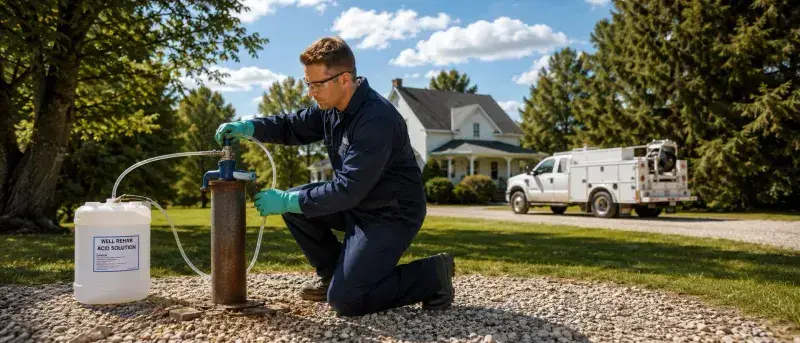
Well Acid Treatment & Rehabilitation in The Blue Mountains
Professional acid treatment services for The Blue Mountains homes, farms, and businesses.
Wells in The Blue Mountains foul almost universally with calcium carbonate scaling. The fractured dolostone aquifer of the Niagara Escarpment dissolves substantial calcium and magnesium into the groundwater, and the same minerals precipitate out on every well screen and casing wall over decades. The hard water that makes Blue Mountains taps and fixtures need descaling does exactly the same thing inside the well itself — only the scaling inside the well steadily blocks the screen openings and chokes off yield. Mighton's Well Services performs hydrochloric or sulfamic acid rehabilitation on calcium-scaled Blue Mountains wells, dissolving the buildup that has accumulated over years. Most local wells recover 80 to 100 percent of original yield after rehabilitation, and chalet properties converting to four-season use often discover their wells can support the new demand once the scaling is cleared.
Local to The Blue Mountains
Based just 25 min away in Stayner. We know the geology and well conditions in your area from decades of experience.
Licensed & Insured
MECP Licensed Well Contractor #C-8303. All work to Ontario Regulation 903 standards with Jeff Mighton (Class 1 & Class 4).
60+ Years Experience
Family-owned since 1964. Trusted by thousands of homeowners, farmers, and businesses across Simcoe County and Grey County.
What to Expect for Acid Treatment in The Blue Mountains
When our team arrives at your property in The Blue Mountains, here's how the process works. Learn more about our full acid treatment process.
Yield Test & Site Assessment
We start with a controlled drawdown test to measure the well's current yield and recovery rate, comparing it to the original well record. The static water level, pump performance, and any historical yield data tell us how much production has been lost and how quickly the decline has happened. This data is the foundation of the treatment plan.
Water Analysis & Downhole Inspection
We collect water samples for laboratory analysis to identify which minerals are present and at what concentrations. Where conditions allow, we run a submersible video camera through the well to see the deposits directly — calcium scale, iron fouling, biological growth, screen condition. This combined diagnostic tells us exactly what chemistry is needed and what yield improvement to expect.
Treatment Plan & Cost Estimate
Based on the diagnostics, we develop a treatment plan covering acid type, concentration, contact time, and any mechanical agitation needed. We provide a firm written estimate covering pump removal, chemicals, treatment labour, redevelopment, disinfection, and water testing. The plan also identifies any expected yield improvement and the realistic ceiling on what rehabilitation can achieve.
Acid Treatment & Mechanical Agitation
On treatment day, the pump is pulled and the well is prepared. The acid is introduced at the calculated concentration — typically a slow gravity feed or pumped delivery to the fouled zone. Mechanical agitation by surging, brushing, or air injection ensures the acid contacts every fouled surface. Contact time is held to the duration needed for the chemistry to fully dissolve the target deposits.
Redevelopment, Disinfection & Verification
After treatment, the well is thoroughly pumped to remove all dissolved deposits and spent acid, with pH monitoring to confirm full neutralization. The well is shock-disinfected, redeveloped until water runs clear, and the pump is reinstalled. A final drawdown test verifies the yield improvement and a water sample goes to the lab for bacterial and chemical testing. We do not return the well to service until results confirm it is safe.
Common Acid Treatment Issues in The Blue Mountains
Severe calcium carbonate scaling in escarpment dolostone wells
Wells drawing from the fractured dolostone of the Niagara Escarpment beneath Blue Mountains accumulate calcium carbonate scale at rates much higher than wells in most other formations. Over twenty to forty years, screen openings can narrow from several millimetres to near-zero, and casing walls develop hard scale several millimetres thick. The same well that produced 10 gallons per minute when drilled may now produce 2 or 3.
For severely scaled escarpment wells, we use hydrochloric acid at concentrations matched to the deposit thickness, with extended contact time and mechanical brushing throughout the screen interval. Yield recovery is typically dramatic — wells that have been steadily declining for decades often return to within 10 to 20 percent of their original capacity in a single rehabilitation cycle.
Chalet conversions discovering wells cannot support year-round demand
Older Blue Mountains chalets being converted to four-season homes routinely discover their wells produce enough for seasonal weekend use but cannot keep up with daily year-round demand. The wells were originally fine — but decades of calcium scaling have reduced yield to a fraction of original, and the seasonal use pattern hid the decline.
Rehabilitation often restores the well to support full-time use, avoiding the cost of drilling a new well as part of the conversion project. We perform yield testing during the conversion planning so you know whether rehabilitation will solve the demand problem or whether a new well is needed. When rehabilitation is the answer, it can be scheduled to fit into the broader renovation timeline.
Hidden artesian zones complicating acid placement
Some Blue Mountains wells intersect zones with significant artesian pressure, which can complicate acid placement and contact time — natural pressure can dilute or displace the acid before it has time to dissolve the target deposits.
For wells with artesian flow, we use controlled placement techniques and may use higher acid concentrations to maintain effective dissolution chemistry against the pressure. Where pressure is severe, temporary wellhead containment can hold the chemistry in place for full contact time. This is a more involved treatment than standard rehabilitation but produces excellent results on these challenging wells.
Plan Blue Mountains Acid Treatment into Chalet Conversion Projects
If you are converting a Blue Mountains chalet to year-round use, schedule a well yield test as part of the planning phase rather than waiting to discover capacity issues after move-in. A pre-conversion rehabilitation often resolves the capacity question before it becomes a problem and fits cleanly into the broader project budget — far better than discovering during the first week of full-time occupancy that the well cannot keep up.
Need Acid Treatment in The Blue Mountains?
Call us for a free phone consultation or request a site visit. We're your local experts.
Acid Treatment in The Blue Mountains: Frequently Asked Questions
My Blue Mountains chalet well used to be fine but cannot keep up since I converted to year-round use. Is acid treatment the answer?
How severe does scaling get in Blue Mountains wells?
How often will I need treatment after the first rehabilitation?
Can acid damage my older Blue Mountains well casing?
How much will Blue Mountains acid treatment cost?
Other Services We Provide in The Blue Mountains
Beyond acid treatment, we offer a full range of well and water services in The Blue Mountains:
We Also Provide Acid Treatment in Nearby Areas
Serving communities across Simcoe County and Grey County from our home base in Stayner.
Serving The Blue Mountains and Surrounding Areas
Ready to Get Started in The Blue Mountains?
Contact our experienced team for a free consultation and estimate. Over 60 years of trusted service.