Well Installation & Completion in Blue Mountains
Professional well installation services for The Blue Mountains homes, farms, and businesses.
Installing a well on the Niagara Escarpment in Blue Mountains requires specialized casing and sealing techniques adapted to shallow limestone bedrock and fractured rock conditions. Where overburden is thin — often just one to three metres — the casing must be seated directly into competent bedrock and the annular space sealed with a cement grout that bonds securely to both the steel casing and the surrounding rock. This casing-in-rock seal is the primary barrier protecting the well from surface water contamination, and in Blue Mountains it takes on heightened importance because the shallow bedrock provides minimal natural filtration. Open fractures at the bedrock surface can channel rain, snowmelt, and runoff directly into the aquifer if the well head area is not properly constructed and sealed. Below the cased portion, the well continues as an open borehole through the limestone and dolostone, with productivity depending on the number and size of water-bearing fractures intersected. In Blue Mountains, we often encounter situations where the well produces from a small number of discrete fractures rather than a broadly permeable zone, which influences how we develop the well and set the pump depth. The pitless adapter must be installed below frost depth, which can be challenging on properties where bedrock extends nearly to the surface. Our crews have refined techniques for these escarpment installations over years of work throughout the Blue Mountains and are equipped to handle every scenario this distinctive geology presents.
Local to The Blue Mountains
Based just 25 min away in Stayner. We know the geology and well conditions in your area from decades of experience.
Licensed & Insured
MECP Licensed Well Contractor #C-8303. All work to Ontario Regulation 903 standards with Jeff Mighton (Class 1 & Class 4).
60+ Years Experience
Family-owned since 1964. Trusted by thousands of homeowners, farmers, and businesses across Simcoe County and Grey County.
What to Expect for Well Installation in The Blue Mountains
When our team arrives at your property in The Blue Mountains, here's how the process works. Learn more about our full well installation process.
Casing & Screen Installation
Based on the drilling log and geological conditions, we select the appropriate casing material and diameter, screen type, and slot size. The casing is lowered into the borehole and seated properly, with screens positioned across the target aquifer zone.
Annular Sealing
We seal the annular space between the casing and borehole wall with approved bentonite or cement grout. The seal is placed from the bottom of the casing up to surface level, with particular attention to sealing through any vulnerable formations that could allow cross-contamination between aquifers.
Well Development & Yield Testing
The well is developed through surging and pumping to remove fine material and establish clear water flow. We then conduct a pumping test to determine the sustainable yield, drawdown characteristics, and recovery rate of the well — essential data for sizing the pump system.
Surface Completion & Pitless Adapter
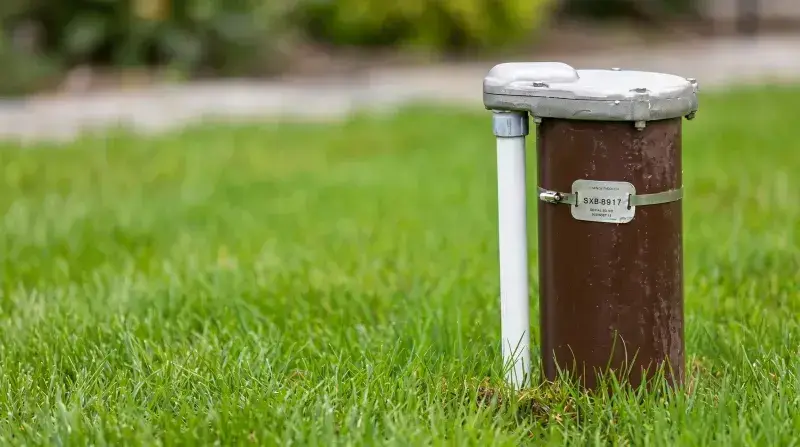
We install the pitless adapter below frost line, connect the horizontal water line to the house, mount a vermin-proof well cap, and ensure the casing extends the required height above finished grade. The well is disinfected and a bacteriological test is submitted before the system is put into service.
Common Well Installation Issues in The Blue Mountains
Casing-in-rock seal failure in fractured limestone
When casing is seated into fractured limestone, the grout can flow away through open fractures rather than filling the annular space around the casing. This leaves gaps in the seal that allow surface water to track down alongside the casing into the well, bypassing the intended protection.
We use controlled-set grout formulations that thicken quickly enough to remain in place without flowing into fractures. In severely fractured rock, we may stage the grouting process, allowing lower sections to set before adding grout above. We verify the seal by monitoring grout volume against the calculated annular volume to confirm complete fill.
Insufficient space for pitless adapter in shallow bedrock
When bedrock is within a metre of the surface, there may not be enough overburden depth to install a pitless adapter below the frost line in the conventional manner. A pitless adapter set too shallow risks freezing in winter, disrupting the water supply.
We use insulated well pit designs or extended casing configurations that create adequate depth for the pitless adapter even where bedrock is shallow. In some cases, we install a well extension that raises the casing above bedrock level and use an insulated, frost-protected connection. Every design ensures the water line connection stays below the frost threshold.
Pump setting depth limited by discrete fracture locations
In Blue Mountains wells, water may enter from one or two specific fractures rather than uniformly along the borehole. Setting the pump above these fractures means the intake zone is too shallow, while setting it too far below wastes the benefit of the productive fractures above.
We log the exact depth of each water-bearing fracture during drilling and set the pump below the lowest productive fracture with adequate submergence. The pump depth is calculated to maintain sufficient water column above the intake during maximum drawdown. This precise placement ensures optimal performance matched to the escarpment fracture geometry.
Consider UV Disinfection Standard Equipment for Blue Mountains Wells
Given the shallow fractured bedrock characteristic of the Blue Mountains escarpment, we recommend treating UV disinfection as standard equipment rather than an optional add-on. The minimal soil cover means surface bacteria can reach the aquifer more readily than in areas with thick overburden. A UV system costs a few hundred dollars to install and pennies per day to operate, providing continuous protection against waterborne bacteria and parasites. It is the best insurance policy for escarpment well owners.
Need Well Installation in The Blue Mountains?
Call us for a free phone consultation or request a site visit. We're your local experts.
Well Installation in The Blue Mountains: Frequently Asked Questions
How do you seal a well casing into escarpment bedrock in Blue Mountains?
Is an open-hole completion safe for a Blue Mountains escarpment well?
What kind of pump do you install in Blue Mountains wells?
How do you handle the frost depth challenge on shallow bedrock properties?
Do Blue Mountains wells need UV disinfection?
Other Services We Provide in The Blue Mountains
Beyond well installation, we offer a full range of well and water services in The Blue Mountains:
We Also Provide Well Installation in Nearby Areas
Serving communities across Simcoe County and Grey County from our home base in Stayner.
Serving The Blue Mountains and Surrounding Areas
Ready to Get Started in The Blue Mountains?
Contact our experienced team for a free consultation and estimate. Over 60 years of trusted service.