Well Decommissioning & Abandonment in Penetanguishene
Professional well decommissioning services for Penetanguishene homes, farms, and businesses.
Penetanguishene's deep history — one of the oldest European settlements in Ontario — shows up in the well decommissioning work we do across the area. Heritage farmsteads with hand-dug wells from the 1800s, waterfront properties along the bay with older wells, and rural lots being severed or sold all generate decommissioning work each year. Mighton's Well Services handles each well type with the appropriate method, with MECP records filed for the permanent property file. The varied geology — shallow bedrock in places, thicker overburden in others — means each well is assessed individually for the right sealing approach.
Local to Penetanguishene
Based just 45 min away in Stayner. We know the geology and well conditions in your area from decades of experience.
Licensed & Insured
MECP Licensed Well Contractor #C-8303. All work to Ontario Regulation 903 standards with Jeff Mighton (Class 1 & Class 4).
60+ Years Experience
Family-owned since 1964. Trusted by thousands of homeowners, farmers, and businesses across Simcoe County and Grey County.
What to Expect for Well Decommissioning in Penetanguishene
When our team arrives at your property in Penetanguishene, here's how the process works. Learn more about our full well decommissioning process.
Site Assessment & Records Review
We start by pulling the Ontario Well Record for the property if one exists and reviewing the original construction details. On the site visit, we inspect the well, confirm depth and condition, and identify any obstacles such as a stuck pump, collapsed casing, or hidden access challenges. For old wells without records, we assess construction type in person.
Written Estimate & Scheduling
We provide a written estimate covering pump and equipment removal, sealing materials and labour, surface restoration, and MECP record filing. The estimate is firm unless we encounter unexpected conditions inside the well, in which case we contact you before any additional work. We schedule the work to fit both your timeline and the seasonal conditions at your property.
Pump & Equipment Removal
On work day, our service rig pulls the pump, drop pipe, safety rope, wiring, and any other equipment from the well. We disconnect the pitless adapter, pressure tank, and pressure switch and remove them from the site or set them aside for disposal as you prefer. The well is now ready for sealing.
Sealing & Casing Removal
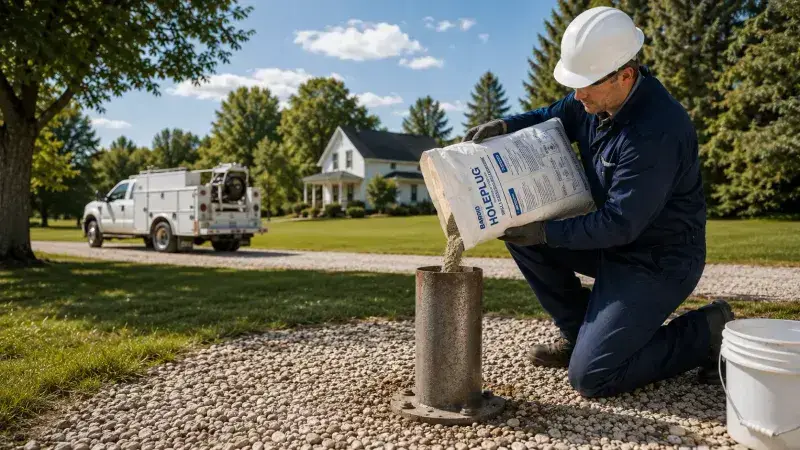
We seal the well from the bottom up using the appropriate approved material — bentonite chips, bentonite grout, or cement-bentonite grout — placed in lifts to ensure continuous contact with the formation. Once the well is fully sealed to surface, the casing is cut at least one metre below grade and either pulled or capped. The surface is backfilled, graded, and restored.
MECP Record Filing & Documentation
We file the Well Decommissioning Record with the Ministry of the Environment within the regulated timeframe and provide you with a copy for your property file. This documentation is what real estate buyers, lenders, and severance applications will ask for — keep it with your other property records.
Common Well Decommissioning Issues in Penetanguishene
Hand-dug wells on heritage Penetanguishene farmsteads
Properties around the older parts of Penetanguishene and into the rural fringes often have hand-dug wells dating to the 1800s — sometimes still partially intact, sometimes mostly collapsed, often hidden under decades of vegetation. These wells must be properly decommissioned under Reg. 903, particularly when the property is severed or sold.
We locate these heritage wells using property records and on-site inspection, assess construction type and condition, and seal them with appropriate materials. Stone cribbing is often left in place to avoid soil collapse, with the lower portion sealed and the upper backfilled with clean material.
Waterfront properties along Georgian Bay with older replaced wells
Penetanguishene shoreline properties have seen turnover and redevelopment as cottages convert to year-round homes. Original wells, often shallow and inadequate for current use, get replaced by new drilled wells — but the originals frequently remain unsealed until a real estate transaction or inspection surfaces them.
We decommission former waterfront wells with appropriate technique for the shoreline location, ensuring no contamination pathway to the bay or to neighbouring wells. The MECP record documents the work for the property file.
Rural severances surfacing multiple wells on previously combined parcels
Severance activity around Penetanguishene's rural edges has split larger properties into smaller lots. Properties that previously had one active well plus several older inactive wells now need each inactive well decommissioned, often as a condition of severance approval.
We inventory all wells on the parcel and decommission the inactive ones as a coordinated package. Records are provided in a format suitable for severance submissions, and multi-well projects benefit from shared mobilization costs.
Address Heritage Wells Before Severance Submission
If you are planning to sever a Penetanguishene heritage property, do a well inventory before submitting the severance application. Severance approvals routinely require decommissioning of any wells on the parcel, and addressing them before the application avoids conditional approvals or delays. We can perform a property-wide inventory and provide a written decommissioning plan covering each well found.
Need Well Decommissioning in Penetanguishene?
Call us for a free phone consultation or request a site visit. We're your local experts.
Well Decommissioning in Penetanguishene: Frequently Asked Questions
My Penetanguishene heritage farm has an old hand-dug well. How is that different from a drilled well?
Can a 150-year-old Penetanguishene well still be properly decommissioned?
How does shoreline proximity affect decommissioning work?
How much does heritage well decommissioning cost in Penetanguishene?
Will I have records suitable for severance applications?
Other Services We Provide in Penetanguishene
Beyond well decommissioning, we offer a full range of well and water services in Penetanguishene:
We Also Provide Well Decommissioning in Nearby Areas
Serving communities across Simcoe County and Grey County from our home base in Stayner.
Serving Penetanguishene and Surrounding Areas
Ready to Get Started in Penetanguishene?
Contact our experienced team for a free consultation and estimate. Over 60 years of trusted service.