Well Drilling Services in Stayner
Professional well drilling services for Stayner homes, farms, and businesses.
Stayner sits in a transitional geological zone where the sandy plains characteristic of the Wasaga Beach lowlands give way to the clay-till uplands that extend toward the Niagara Escarpment. This transitional position means that drilling conditions in Stayner can change significantly depending on exactly where your property is located within the community. Properties on the east side of town may encounter sandier soils similar to those found closer to the Nottawasaga River, while properties to the west and south often hit denser clay-till deposits that require different drilling approaches. The overburden thickness in Stayner generally ranges from moderate to substantial, with bedrock consisting primarily of limestone from the Paleozoic sequence that underlies much of Simcoe County. Our drilling crews have worked extensively throughout Stayner and the surrounding Clearview Township, building a detailed understanding of how local geology affects well yield and water quality. We use this accumulated knowledge to select the optimal drilling location on your property and anticipate the formations we will encounter. Groundwater quality in Stayner varies with aquifer type: overburden wells in sandy zones may produce softer water, while bedrock wells often yield harder water with elevated mineral content. Every Stayner drilling project includes comprehensive water testing so you know exactly what treatment, if any, your new well requires.
Local to Stayner
Based just 0 min (home base) away in Stayner. We know the geology and well conditions in your area from decades of experience.
Licensed & Insured
MECP Licensed Well Contractor #C-8303. All work to Ontario Regulation 903 standards with Jeff Mighton (Class 1 & Class 4).
60+ Years Experience
Family-owned since 1964. Trusted by thousands of homeowners, farmers, and businesses across Simcoe County and Grey County.
What to Expect for Well Drilling in Stayner
When our team arrives at your property in Stayner, here's how the process works. Learn more about our full well drilling process.
Site Assessment & Well Siting
We visit your property to evaluate geological conditions, identify the optimal well location based on regulatory setbacks, accessibility for drilling equipment, and proximity to the home or building. We review existing well records in the area to estimate expected depth and yield.
Drilling
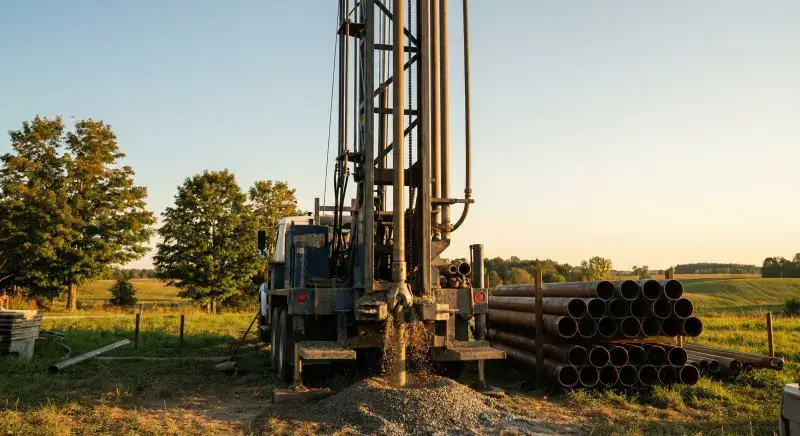
Using Rotary or Cable Tool methods based on site geology, we drill through overburden and into the aquifer-bearing formation. We log the geological formations encountered and identify the most productive water-bearing zone for well completion.
Well Completion & Casing
We install steel or PVC casing to the required depth, set stainless steel screens where appropriate, and seal the annular space with bentonite or cement grout to prevent surface contamination from reaching the aquifer. A vermin-proof well cap is installed at surface.
Development & Testing
The well is developed by surging and pumping to remove drilling fluids and fine sediment, maximizing water flow from the aquifer. We conduct a pump test to measure the well yield and determine the appropriate pump size. The well record is filed with the Ministry of the Environment.
Common Well Drilling Issues in Stayner
Encountering unexpected clay layers during drilling
The transitional geology around Stayner means that clay-till deposits can appear at varying depths without warning. Dense clay layers slow drilling progress and can seal off potential water-bearing zones, forcing the drill to go deeper than initially estimated.
Our crews are prepared to adjust drilling techniques when transitioning between sand and clay formations. We maintain detailed records of previous Stayner wells we have drilled, allowing us to anticipate formation changes and plan accordingly. We communicate transparently about progress as we drill through each layer.
Low well yield in clay-dominated areas
Properties situated on the clay-till upland side of Stayner sometimes produce wells with lower yields because clay formations do not transmit water as readily as sand or fractured rock. A well that looks good on paper may only produce two or three litres per minute.
When we encounter clay-heavy conditions, we drill into the underlying bedrock to access fracture zones with better flow rates. We also conduct extended pump tests to verify that the well can sustain household demand before finalizing the installation. If yield remains marginal, we size the storage and pump system to accommodate the slower recovery.
Hard water from limestone bedrock aquifers
Many Stayner wells draw from limestone bedrock aquifers where the water dissolves calcium and magnesium as it moves through the rock. This produces very hard water that causes scale buildup in pipes, water heaters, and appliances, and leaves white residue on fixtures.
We test water hardness as part of every new well completion in Stayner. Where hardness levels are high, we recommend appropriate water softening equipment sized for your household. Installing treatment at the time of well completion is more cost-effective than retrofitting later.
Understand the Geology Beneath Your Stayner Property
Before your well is drilled, ask us about the well records from neighbouring properties. Because Stayner straddles a geological boundary between sand plains and clay uplands, your neighbour half a kilometre away may have had a very different drilling experience. Knowing what to expect helps you budget accurately and set realistic expectations for well depth and water quality. We are happy to walk you through the local well data at no charge.
Need Well Drilling in Stayner?
Call us for a free phone consultation or request a site visit. We're your local experts.
Well Drilling in Stayner: Frequently Asked Questions
What makes drilling in Stayner different from other areas you serve?
How deep are most wells in Stayner?
Will I need a water softener with a new Stayner well?
Can you drill a well in Stayner during winter?
What yield should I expect from a new well in Stayner?
Other Services We Provide in Stayner
Beyond well drilling, we offer a full range of well and water services in Stayner:
We Also Provide Well Drilling in Nearby Areas
Serving communities across Simcoe County and Grey County from our home base in Stayner.
Serving Stayner and Surrounding Areas
Ready to Get Started in Stayner?
Contact our experienced team for a free consultation and estimate. Over 60 years of trusted service.